
UNIFIT
UNIFIT
UX CASE STUDY • CONCEPT • 2025
UX CASE STUDY • CONCEPT • 2025
ROLE
ROLE
Product Designer (UI/UX)
Researcher
Systems Thinking
Product Designer (UI/UX)
Researcher
Systems Thinking
TIMELINE
TIMELINE
2–3 weeks
2–3 weeks
DELIVERABLES
DELIVERABLES
Research insights
User flows + IA
Key screens + states
Rationale notes
Research insights
User flows + IA
Key screens + states
Rationale notes
SKILLS
SKILLS
UX Research
Information Architecture
Interaction Design
UI Design
Design Systems
Prototyping
Product Thinking
UX Research
Information Architecture
Interaction Design
UI Design
Design Systems
Prototyping
Product Thinking
OVERVIEW
OVERVIEW
How do you help college students stay fit without breaking their routine?
How do you help college students stay fit without breaking their routine?
Unifit is a student focused fitness concept I designed across two iterations: first at UID 2024, then refined at Srishti 2025 with stronger flows, states, and visual consistency.
The goal was to make fitness feel repeatable, by combining planning, quick workouts, progress feedback, and simple guidance without turning the experience into a heavy tracking app.
Unifit is a student focused fitness concept I designed across two iterations: first at UID 2024, then refined at Srishti 2025 with stronger flows, states, and visual consistency.
The goal was to make fitness feel repeatable, by combining planning, quick workouts, progress feedback, and simple guidance without turning the experience into a heavy tracking app.
Research + Insights
Research + Insights
Synthesised student routines, constraints, and motivation patterns into clear product priorities
Synthesised student routines, constraints, and motivation patterns into clear product priorities
Key screens + states
Designed critical screens and edge states that make “what next” obvious across the experience
Core flows + IA
Mapped key journeys like onboarding, workout selection, scheduling, and progress so navigation stays predictable
Core flows + IA
Core flows + IA
Mapped key journeys like onboarding, workout selection, scheduling, and progress so navigation stays predictable
Mapped key journeys like onboarding, workout selection, scheduling, and progress so navigation stays predictable
Key screens + states
Key screens + states
Designed critical screens and edge states that make “what next” obvious across the experience
Designed critical screens and edge states that make “what next” obvious across the experience
THE REALITY CHECK
THE REALITY CHECK
Constraints I designed around
Constraints I designed around
Concept project, not a shipped product
So I focused on believable flows, clear states, and a system that could scale later, instead of pretending I had real usage metrics.
Student routines are unstable by default
Concept project, not a shipped product
So I designed around irregular schedules, low energy days, and short attention windows, not “perfect” gym consistency
So I focused on believable flows, clear states, and a system that could scale later, instead of pretending I had real usage metrics.
Student routines are unstable by default
So I designed around irregular schedules, low energy days, and short attention windows, not “perfect” gym consistency
Two iterations, two contexts
So I treated UID 2024 as the base concept and Srishti 2025 as a refinement pass where I tightened IA, interactions, and visual consistency.
Scope had to stay controlled
So I went deep on a few high impact journeys and made them feel complete, instead of designing every feature a fitness app could have.
Two iterations, two contexts
Concept project, not a shipped product
So I treated UID 2024 as the base concept and Srishti 2025 as a refinement pass where I tightened IA, interactions, and visual consistency.
So I focused on believable flows, clear states, and a system that could scale later, instead of pretending I had real usage metrics.
Student routines are unstable by default
So I designed around irregular schedules, low energy days, and short attention windows, not “perfect” gym consistency
Two iterations, two contexts
So I treated UID 2024 as the base concept and Srishti 2025 as a refinement pass where I tightened IA, interactions, and visual consistency.
Scope had to stay controlled
So I went deep on a few high impact journeys and made them feel complete, instead of designing every feature a fitness app could have.
Scope had to stay controlled
So I went deep on a few high impact journeys and made them feel complete, instead of designing every feature a fitness app could have.
Concept project, not a shipped product
So I focused on believable flows, clear states, and a system that could scale later, instead of pretending I had real usage metrics.
Student routines are unstable by default
So I designed around irregular schedules, low energy days, and short attention windows, not “perfect” gym consistency
Two iterations, two contexts
So I treated UID 2024 as the base concept and Srishti 2025 as a refinement pass where I tightened IA, interactions, and visual consistency.
Scope had to stay controlled
So I went deep on a few high impact journeys and made them feel complete, instead of designing every feature a fitness app could have.
RESEARCH & INSIGHTS
RESEARCH & INSIGHTS
What stops students from staying consistent, even when they want to?
What stops students from staying consistent, even when they want to?
I used a mix of survey + cultural probes + interviews, then translated the findings into personas, maps, and clear design implications before moving into flows and screens.
I used a mix of survey + cultural probes + interviews, then translated the findings into personas, maps, and clear design implications before moving into flows and screens.

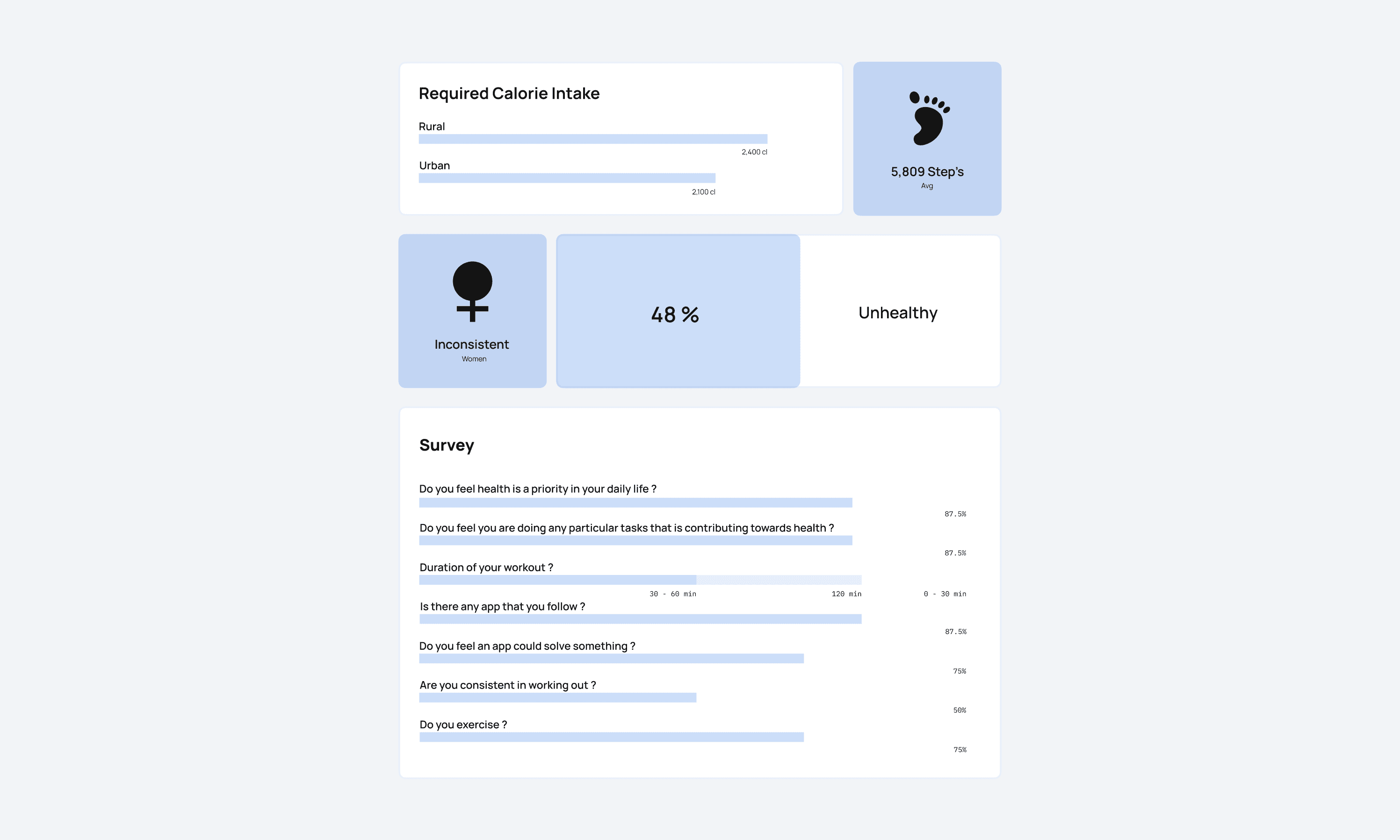
Captured broad patterns around student fitness habits, drop-offs, and what people actually prioritise day to day. Used it to spot themes worth going deeper into.
Captured broad patterns around student fitness habits, drop-offs, and what people actually prioritise day to day. Used it to spot themes worth going deeper into.
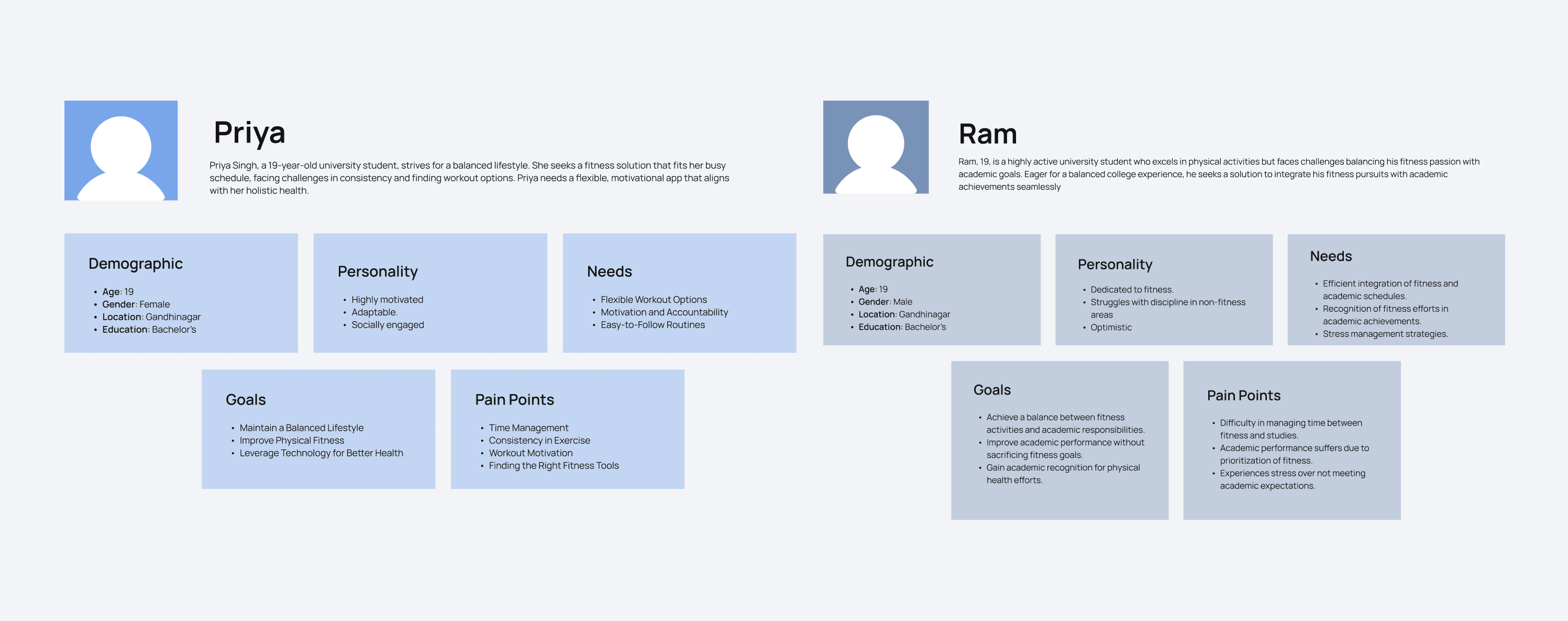
Turned scattered behaviours into clear user archetypes, so every feature decision had a real student or trainer in mind. Helped keep the product focused instead of feature-heavy
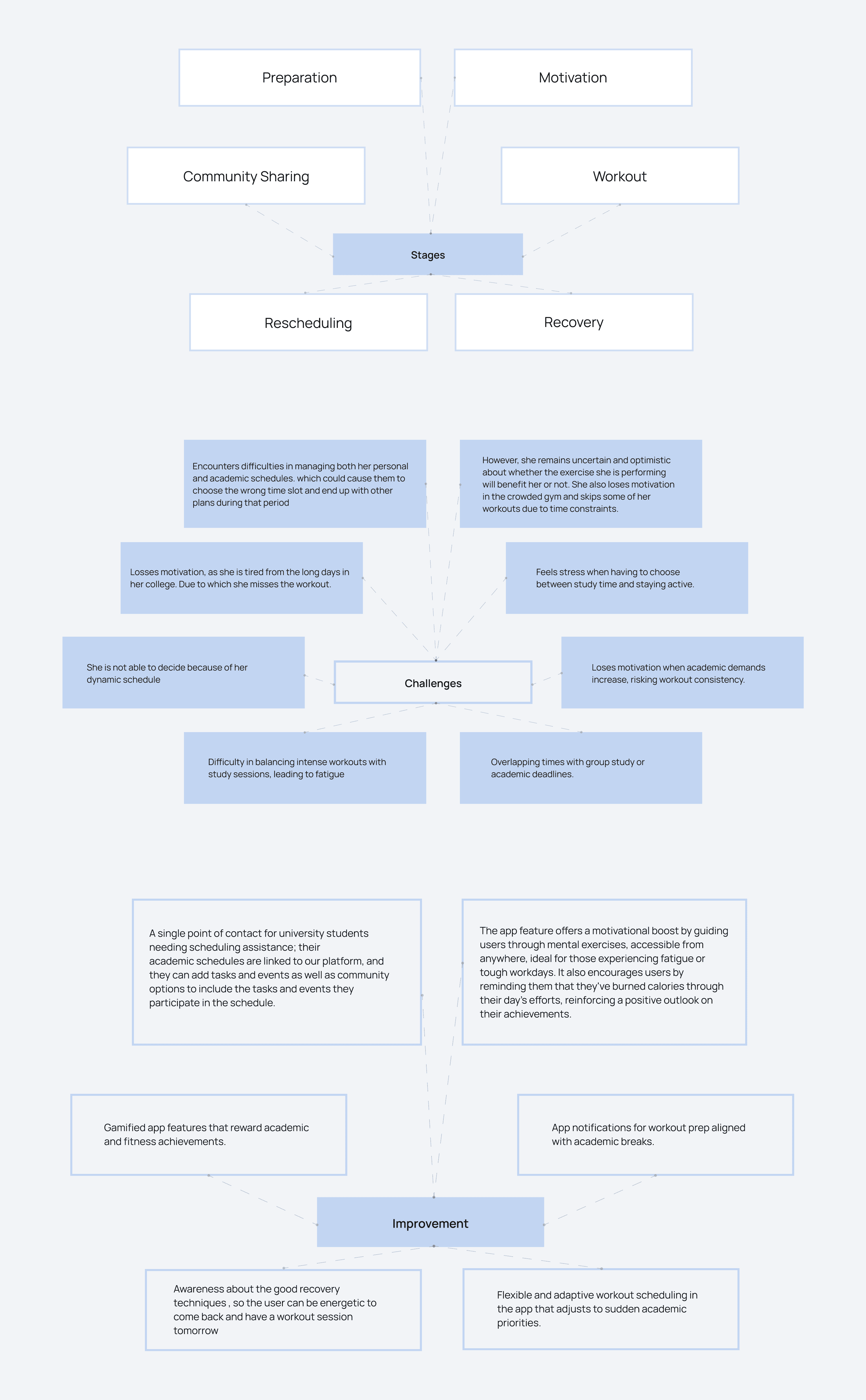
Mapped the full routine from intention to follow-through and where it breaks. Made friction points visible across planning, doing, and recovery.
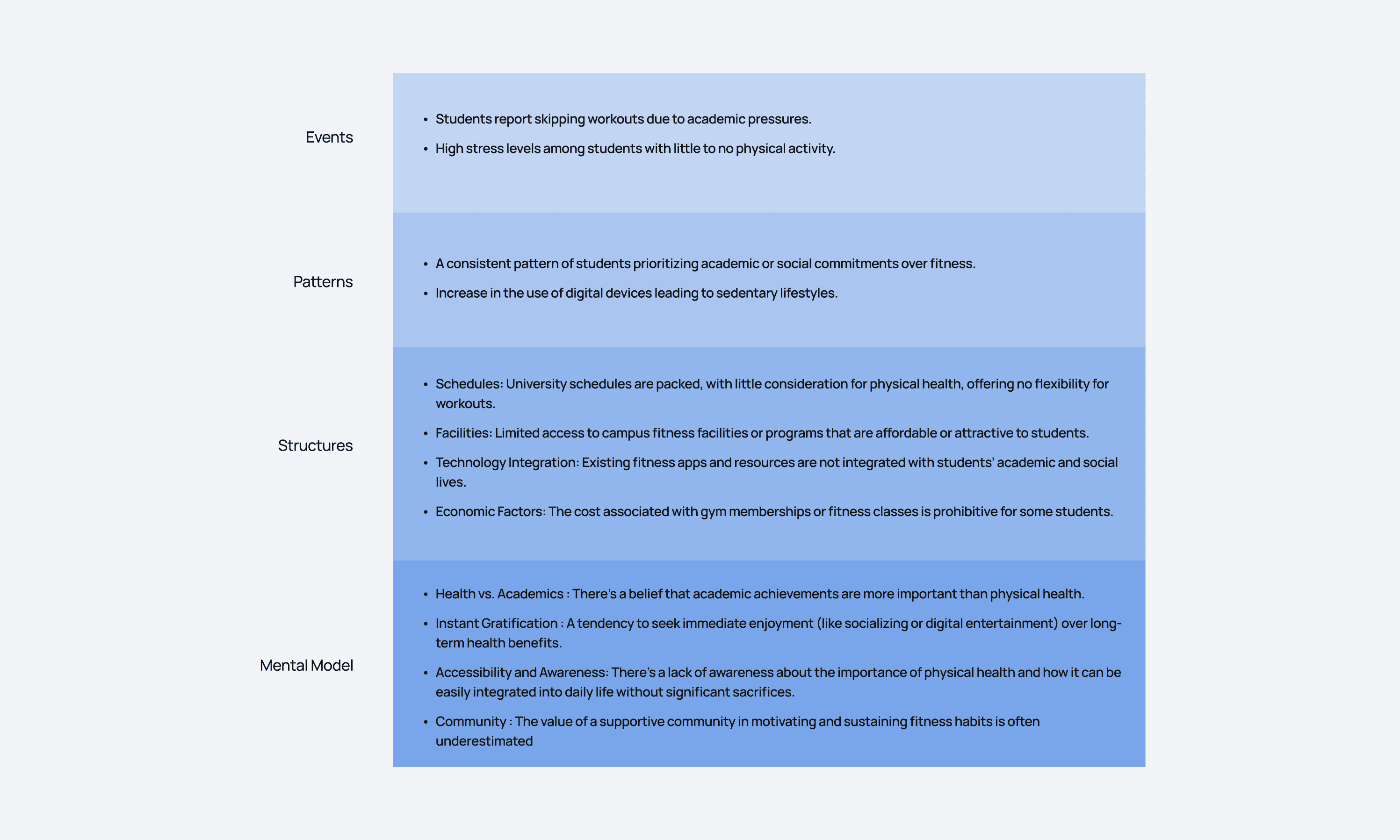
Separated surface problems like skipping workouts from deeper causes like motivation cycles, time anxiety, and environment. Helped define the real problem the product should solve
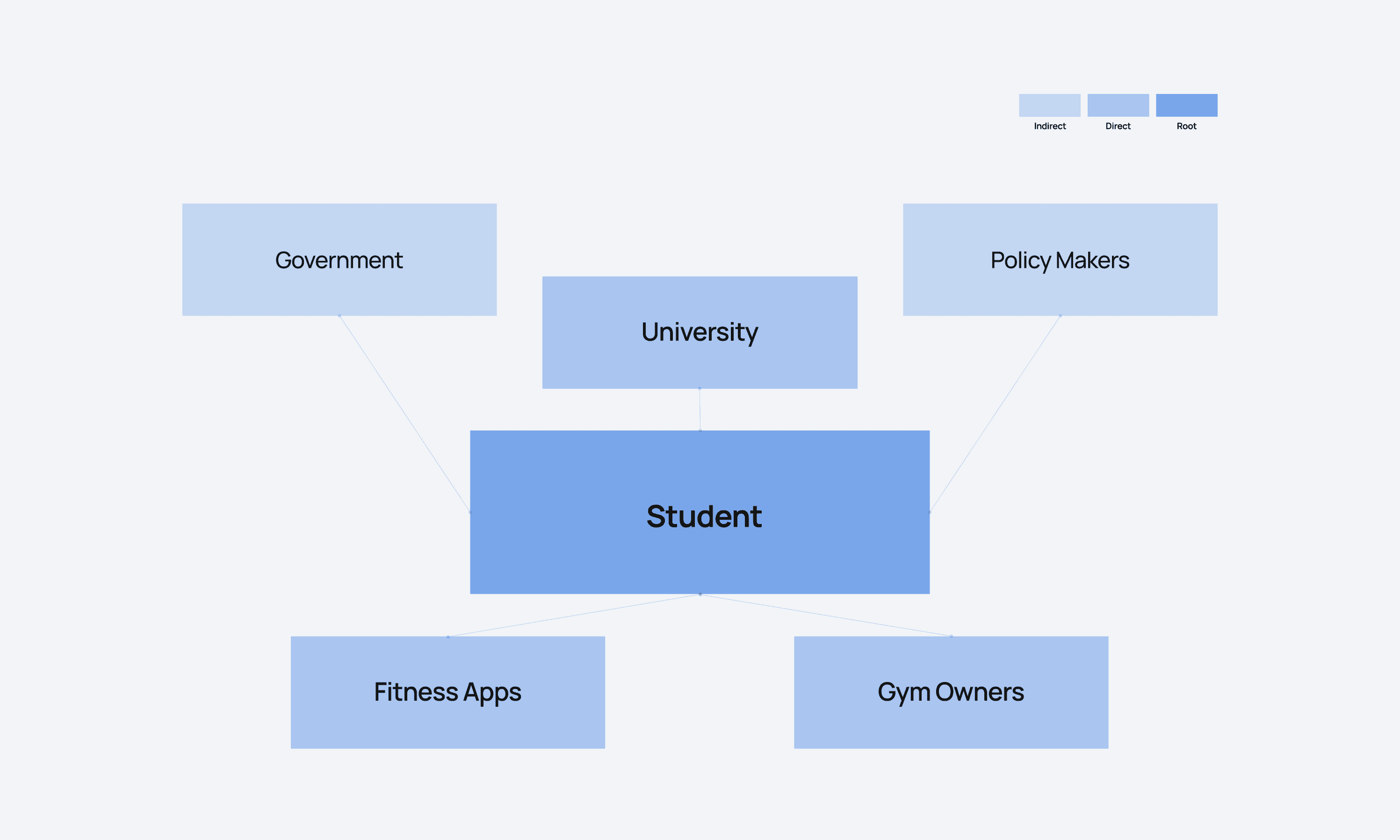
Clarified who shapes the experience beyond the user: trainers, gyms, peers, and platforms. Helped prioritise what needs coordination versus what can be self-serve.
Turned scattered behaviours into clear user archetypes, so every feature decision had a real student or trainer in mind. Helped keep the product focused instead of feature-heavy
Mapped the full routine from intention to follow-through and where it breaks. Made friction points visible across planning, doing, and recovery.
Separated surface problems like skipping workouts from deeper causes like motivation cycles, time anxiety, and environment. Helped define the real problem the product should solve
Clarified who shapes the experience beyond the user: trainers, gyms, peers, and platforms. Helped prioritise what needs coordination versus what can be self-serve.
Fitness starts before the workout
Students often drop off before they even begin because of mental fatigue and overwhelming experiences. This pushed Unifit’s direction toward calmer, quick, non-judgmental onboarding.
Students often drop off before they even begin because of mental fatigue and overwhelming experiences. This pushed Unifit’s direction toward calmer, quick, non-judgmental onboarding.
Health is hidden in everyday patterns
Many students don’t count walking, stairs, skipped meals, hydration, or sleep as “health behaviour,” even when it’s shaping their day. This led to tracking micro-habits so health feels continuous, not only gym-based.
Motivation in college isn’t one-size-fits-all
Motivation clusters vary and can be emotional, social, or situational. This influenced the idea of organizing workouts around intent or mindset, not only time and type
Health is hidden in everyday patterns
Many students don’t count walking, stairs, skipped meals, hydration, or sleep as “health behaviour,” even when it’s shaping their day. This led to tracking micro-habits so health feels continuous, not only gym-based.
Motivation in college isn’t one-size-fits-all
Motivation clusters vary and can be emotional, social, or situational. This influenced the idea of organizing workouts around intent or mindset, not only time and type
Fitness starts before the workout
Students often drop off before they even begin because of mental fatigue and overwhelming experiences. This pushed Unifit’s direction toward calmer, quick, non-judgmental onboarding.
Health is hidden in everyday patterns
Context-aware patterns like quick views and clearer states so users don’t lose their place
Motivation in college isn’t one-size-fits-all
Motivation clusters vary and can be emotional, social, or situational. This influenced the idea of organizing workouts around intent or mindset, not only time and type
SOLUTION
SOLUTION
A student health system that works around college life, not against it
A student health system that works around college life, not against it
Unifit is a concept fitness platform for university students that brings workouts, routines, and basic health tracking into one place, while staying realistic about academic pressure and changing schedules. The core idea is simple: if a student’s day is already planned around classes and deadlines, fitness needs to adapt to that reality, not demand extra effort.
Instead of treating health as only gym sessions, Unifit frames progress through a mix of workouts and everyday micro habits like steps, hydration, and sleep, supported by light motivation and reward loops that make consistency easier to maintain during busy weeks.
Unifit is a concept fitness platform for university students that brings workouts, routines, and basic health tracking into one place, while staying realistic about academic pressure and changing schedules. The core idea is simple: if a student’s day is already planned around classes and deadlines, fitness needs to adapt to that reality, not demand extra effort.
Instead of treating health as only gym sessions, Unifit frames progress through a mix of workouts and everyday micro habits like steps, hydration, and sleep, supported by light motivation and reward loops that make consistency easier to maintain during busy weeks.
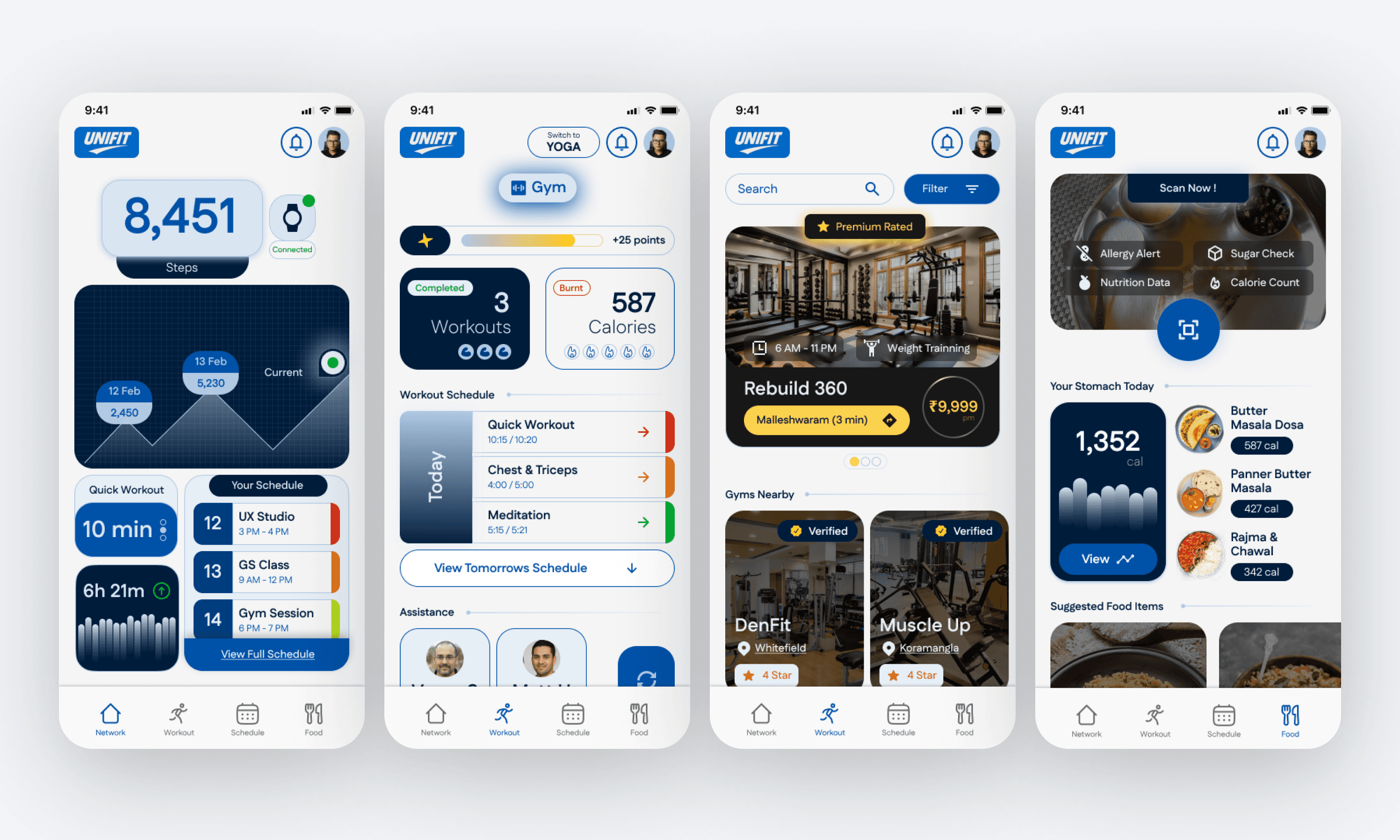
Academics-aware scheduling
Academic schedules are part of the planning layer, so workouts and tasks can be placed or shifted without clashing with real college commitments.
Health beyond the gym
Daily routines still count. Unifit recognises and reinforces progress through steps, sleep, and small habits so students don’t feel like they “failed” just because they missed one workout
Motivation that survives bad weeks
When energy drops and schedules get unpredictable, the system supports consistency through reminders, emotional support cues, and gamified rewards tied to academic and fitness effort.
Health beyond
the gym
Daily routines still count. Unifit recognises and reinforces progress through steps, sleep, and small habits so students don’t feel like they “failed” just because they missed one workout
Motivation that survives bad weeks
When energy drops and schedules get unpredictable, the system supports consistency through reminders, emotional support cues, and gamified rewards tied to academic and fitness effort.
Academics-aware scheduling
Academic schedules are part of the planning layer, so workouts and tasks can be placed or shifted without clashing with real college commitments.
Health beyond the gym
Daily routines still count. Unifit recognises and reinforces progress through steps, sleep, and small habits so students don’t feel like they “failed” just because they missed one workout
Motivation that survives bad weeks
When energy drops and schedules get unpredictable, the system supports consistency through reminders, emotional support cues, and gamified rewards tied to academic and fitness effort.
CORE FLOWS
CORE FLOWS
Unifit’s main loops, built around a student day
Unifit’s main loops, built around a student day
These are the everyday journeys that make the concept work: quick actions, clear feedback, and a schedule that respects academics
These are the everyday journeys that make the concept work: quick actions, clear feedback, and a schedule that respects academics
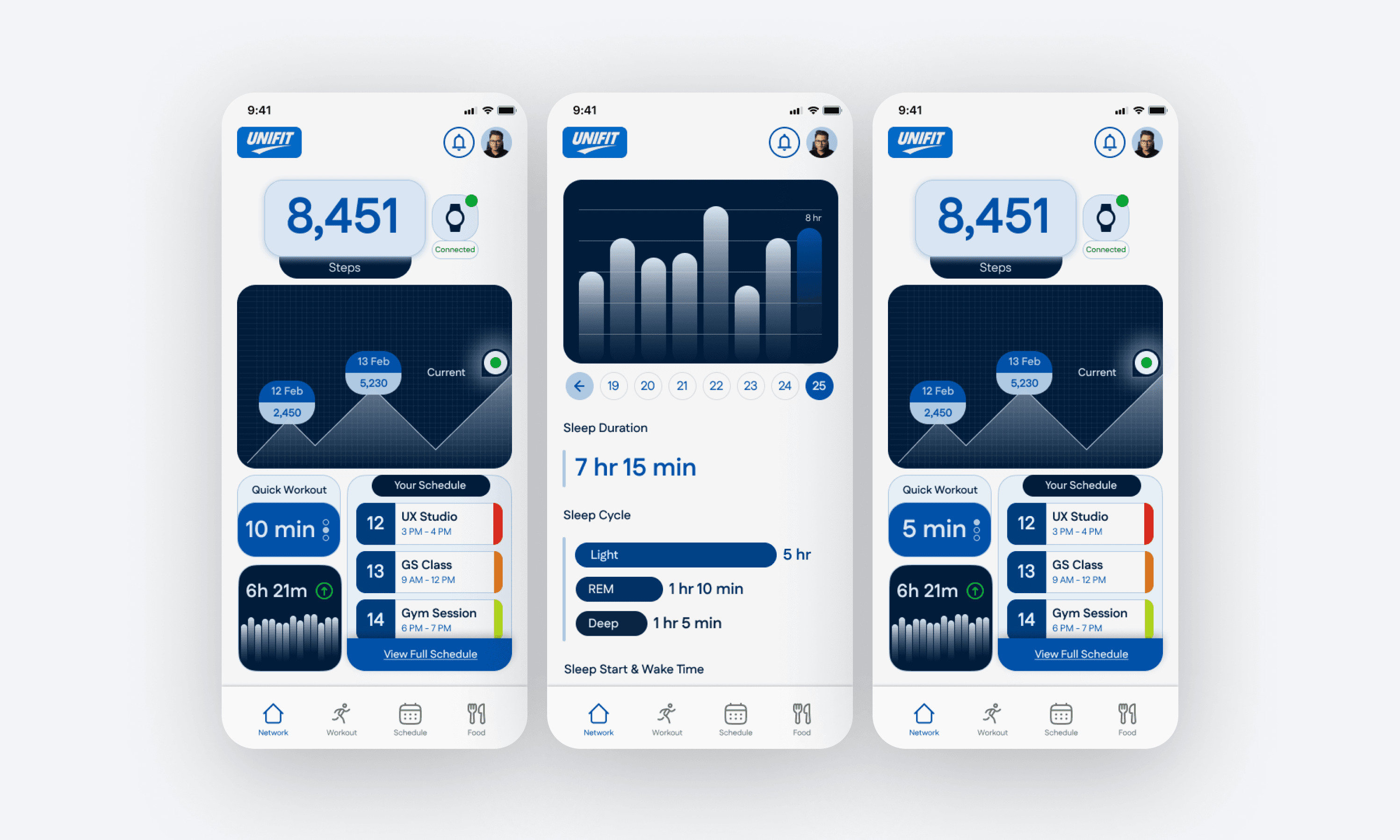
Starting fast from the home dashboard
A single surface to check today’s basics and jump into a workout in seconds
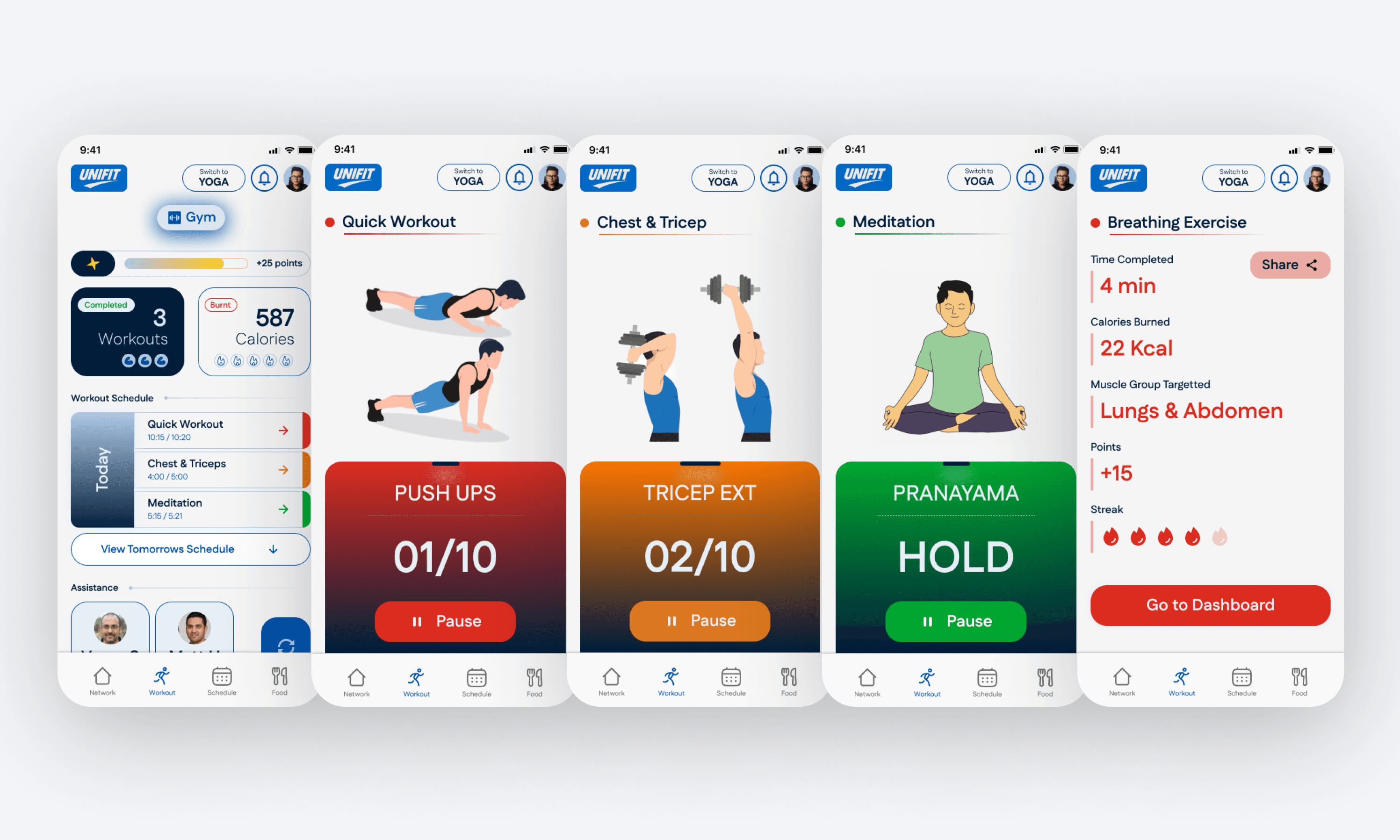
Workouts with instant feedback
Pick a workout style, follow the session, then see a simple summary so progress feels tangible.
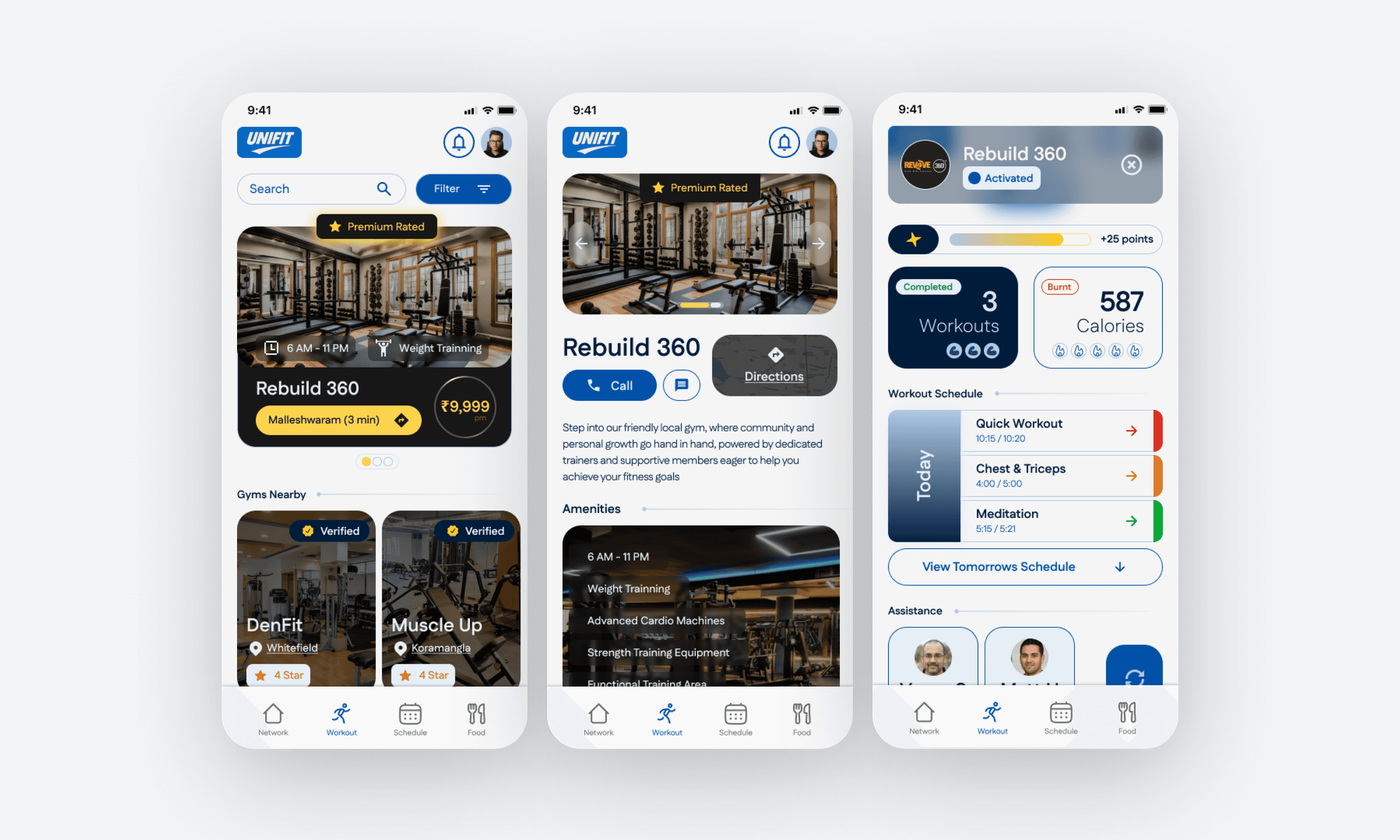
Finding and adding a gym
A lightweight discovery and add flow that saves a gym once and keeps it ready for future planning
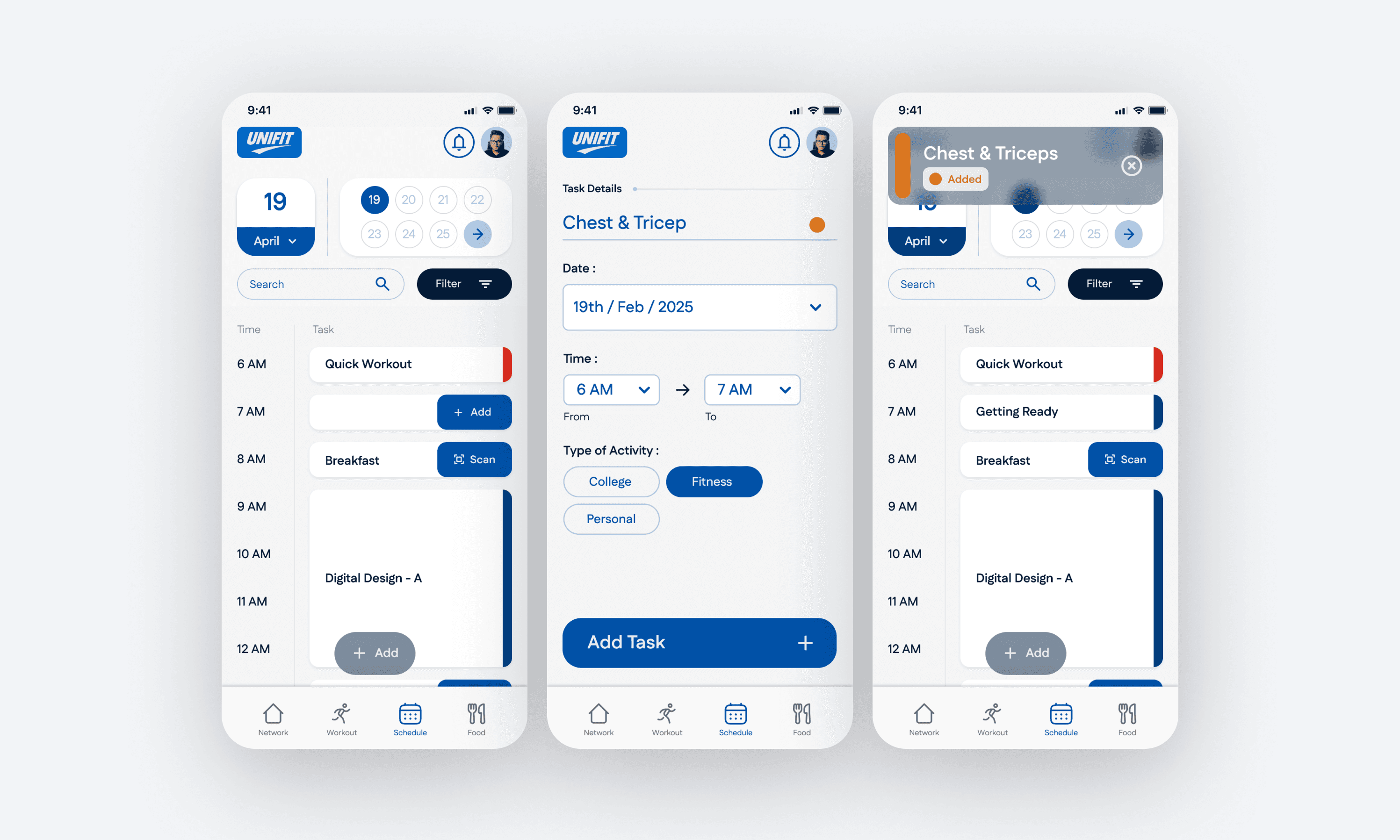
Planning fitness around academics
A unified schedule where workouts sit next to classes and tasks so fitness becomes part of the routine, not a separate app
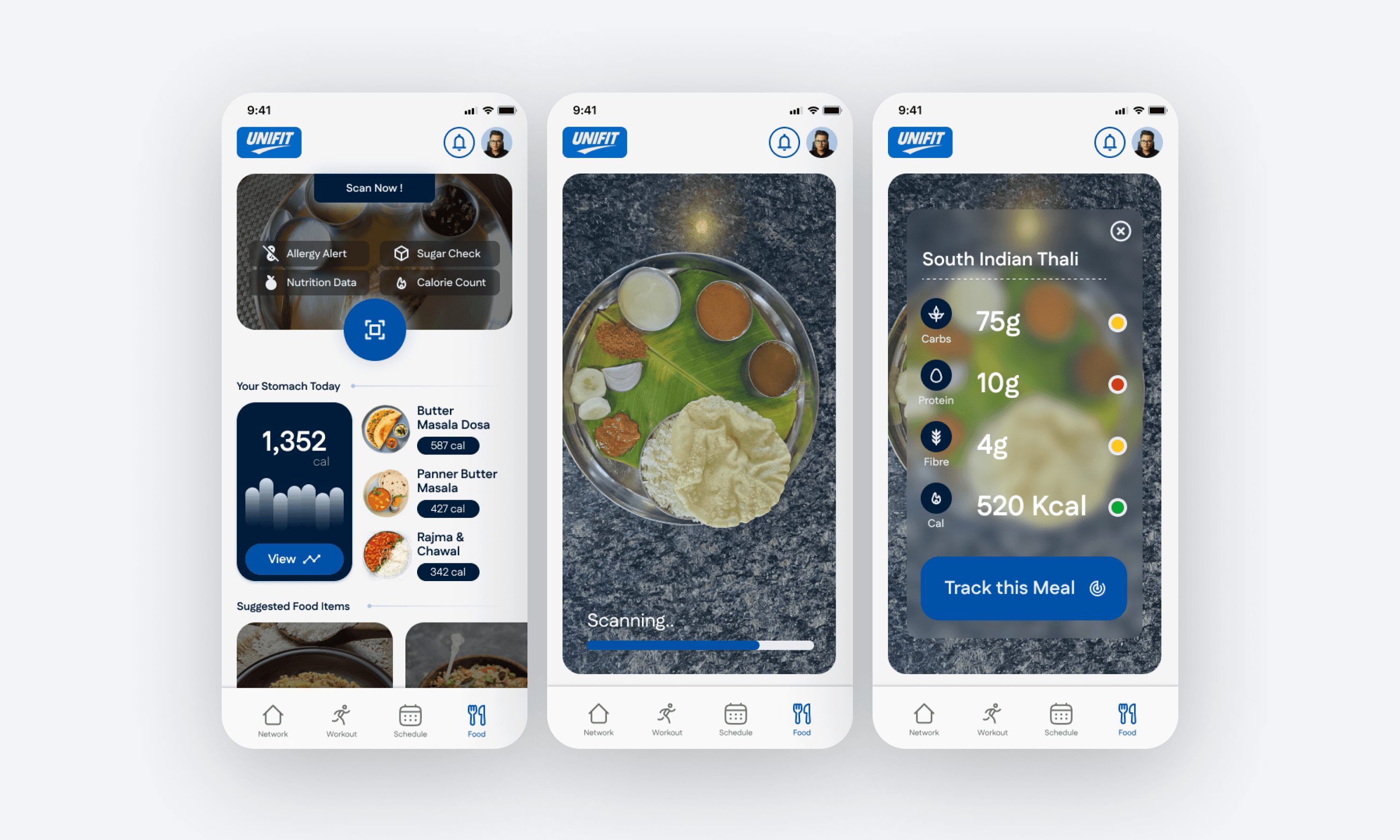
Food tracking through a quick scan
Capture a meal, get basic nutrition, and log it without turning tracking into a full-time job
Workouts with instant feedback
Pick a workout style, follow the session, then see a simple summary so progress feels tangible.
Finding and adding a gym
A lightweight discovery and add flow that saves a gym once and keeps it ready for future planning
Planning fitness around academics
A unified schedule where workouts sit next to classes and tasks so fitness becomes part of the routine, not a separate app
Food tracking through a quick scan
Capture a meal, get basic nutrition, and log it without turning tracking into a full-time job
Starting fast from the home dashboard
A single surface to check today’s basics and jump into a workout in seconds
Workouts with instant feedback
Pick a workout style, follow the session, then see a simple summary so progress feels tangible.
Finding and adding a gym
A lightweight discovery and add flow that saves a gym once and keeps it ready for future planning
Planning fitness around academics
A tighter loop from discovery to save to apply, with less clutter and stronger decision support
Food tracking through a quick scan
Capture a meal, get basic nutrition, and log it without turning tracking into a full-time job
DESIGN DECISIONS
DESIGN DECISIONS
Design decisions for faster scanning and clearer intent
Design decisions for faster scanning and clearer intent
I focused on reducing cognitive load in the places people move fastest on LinkedIn: first-time entry, profile browsing, and feed reading. The goal was simple navigation, predictable interactions, and less visual clutter
I focused on reducing cognitive load in the places people move fastest on LinkedIn: first-time entry, profile browsing, and feed reading. The goal was simple navigation, predictable interactions, and less visual clutter
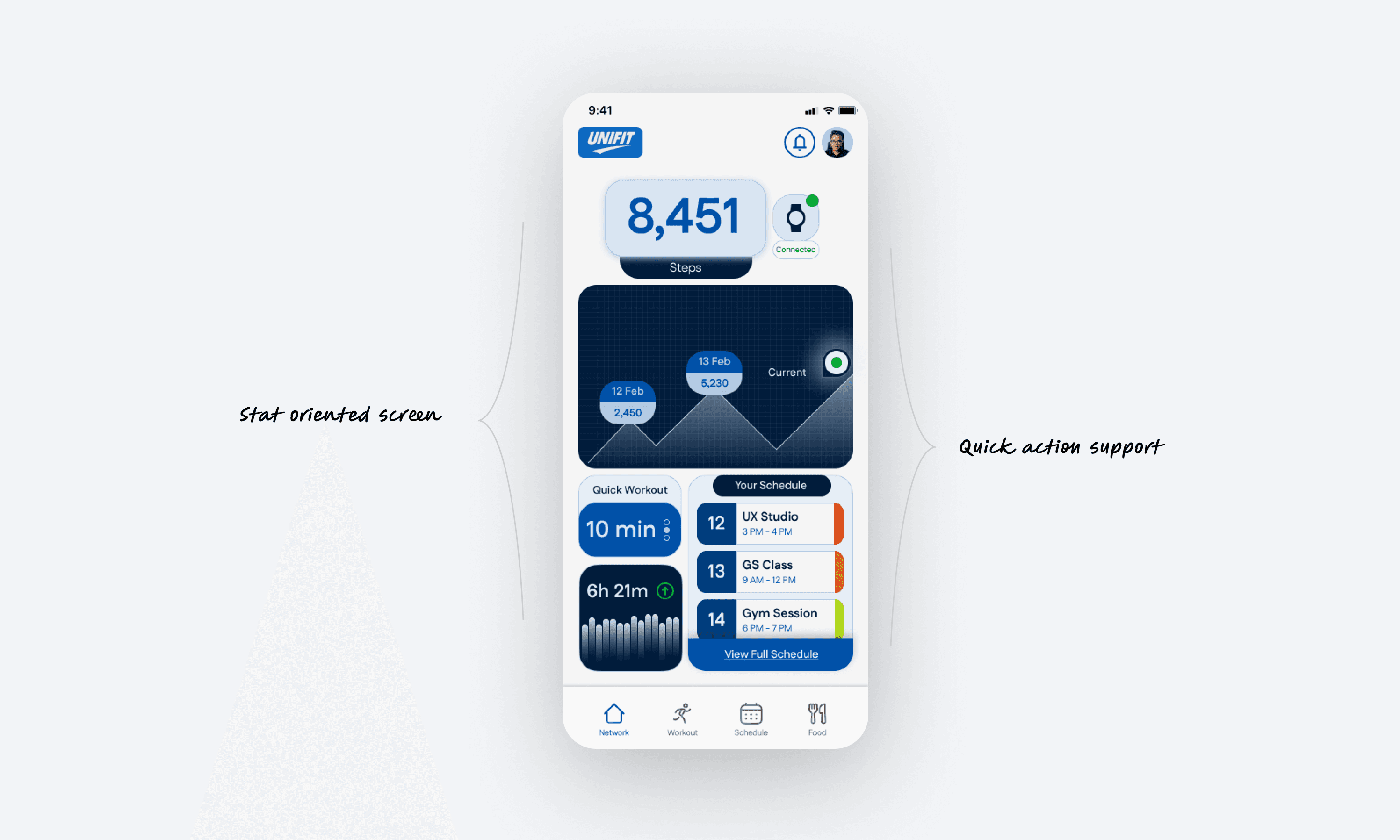
A single glance surface that balances health signals (steps, sleep) with today’s academic reality, so users can act without digging
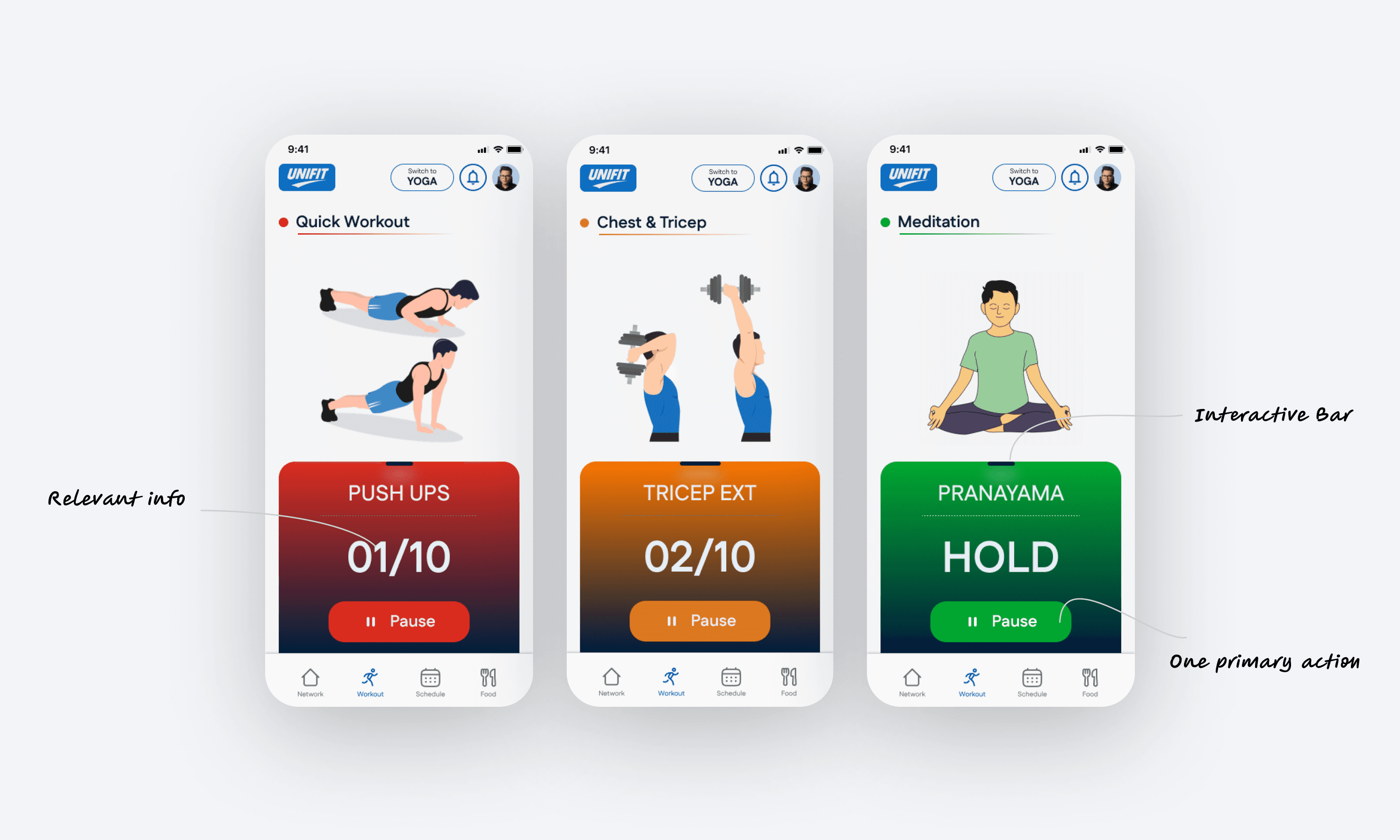
One primary action, minimal controls, and mode-specific visuals keep the user focused mid-workout, not managing the U
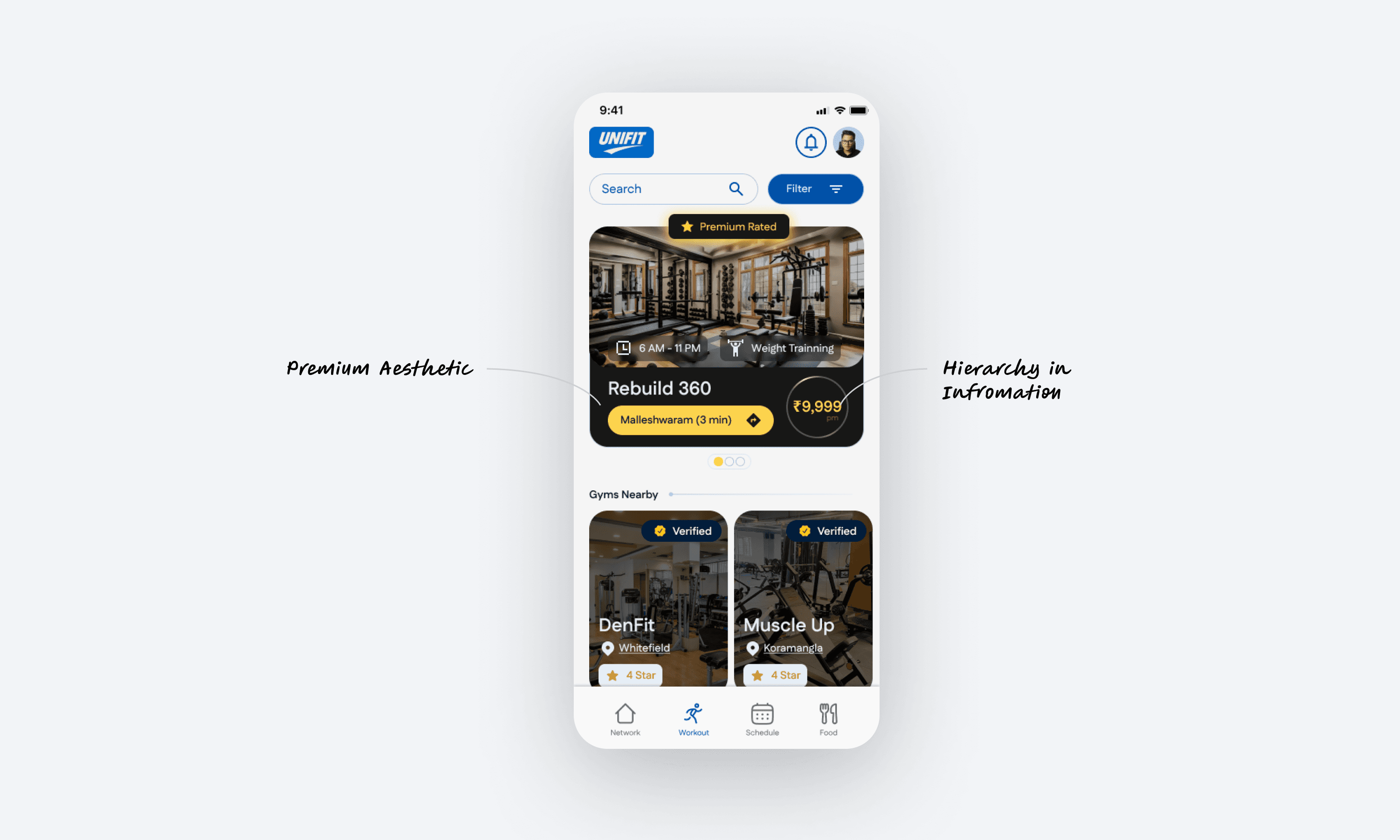
Decision-critical info is prioritised (distance, price, timing, type) so comparing gyms feels fast and low-effort
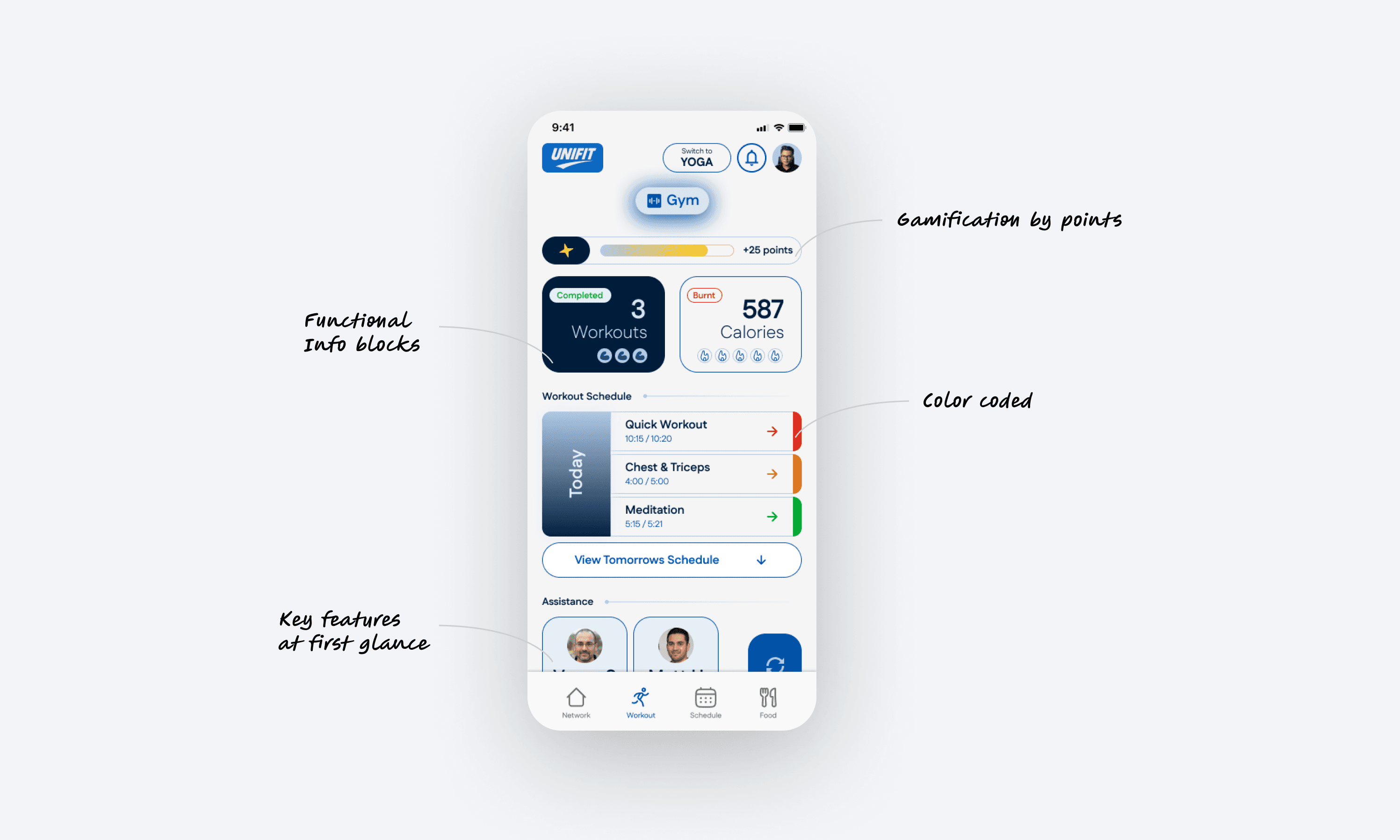
Progress is framed as small, finishable blocks with visible rewards, so motivation stays high without needing long sessions
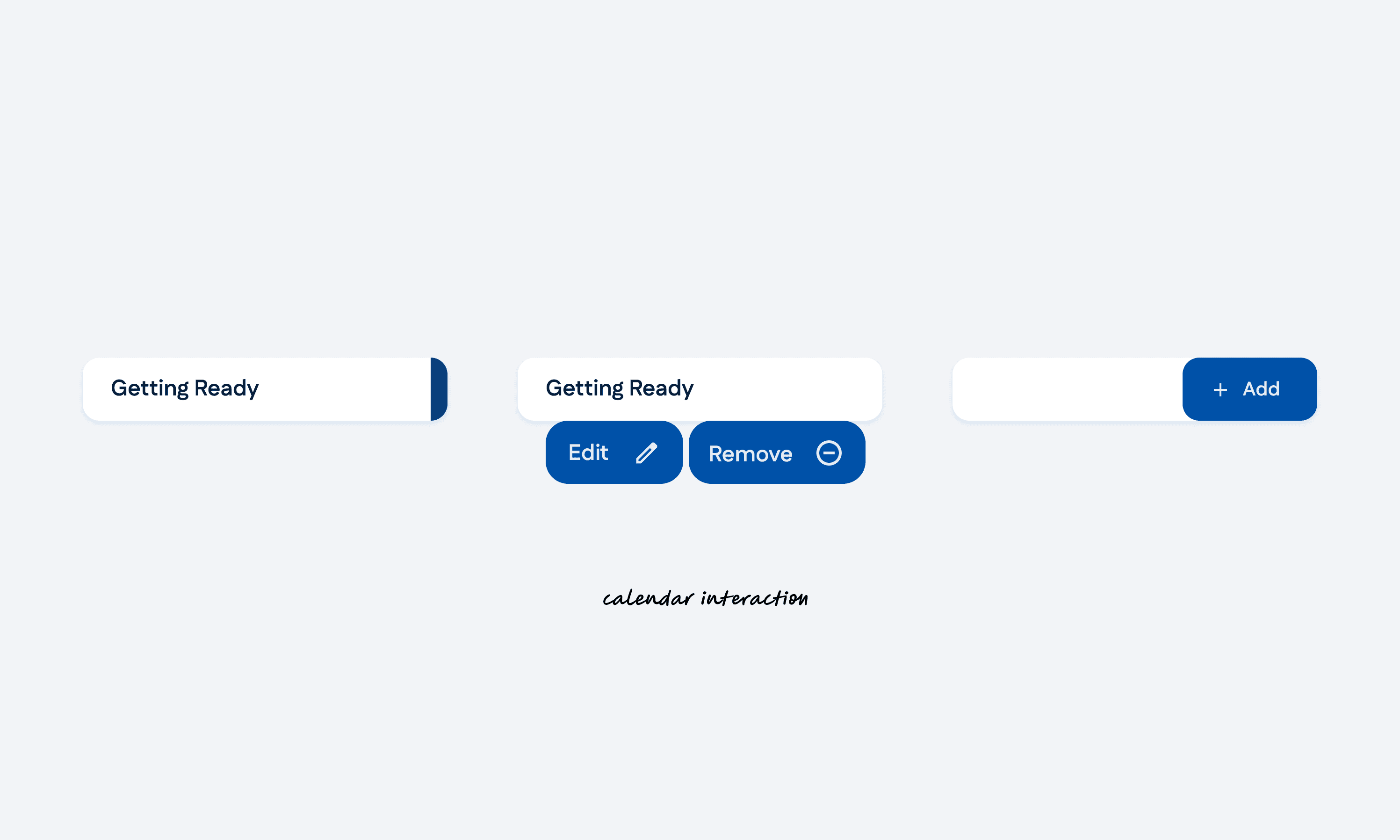
A single reusable control handles add and edit states cleanly, so planning workouts alongside classes stays lightweight and consistent
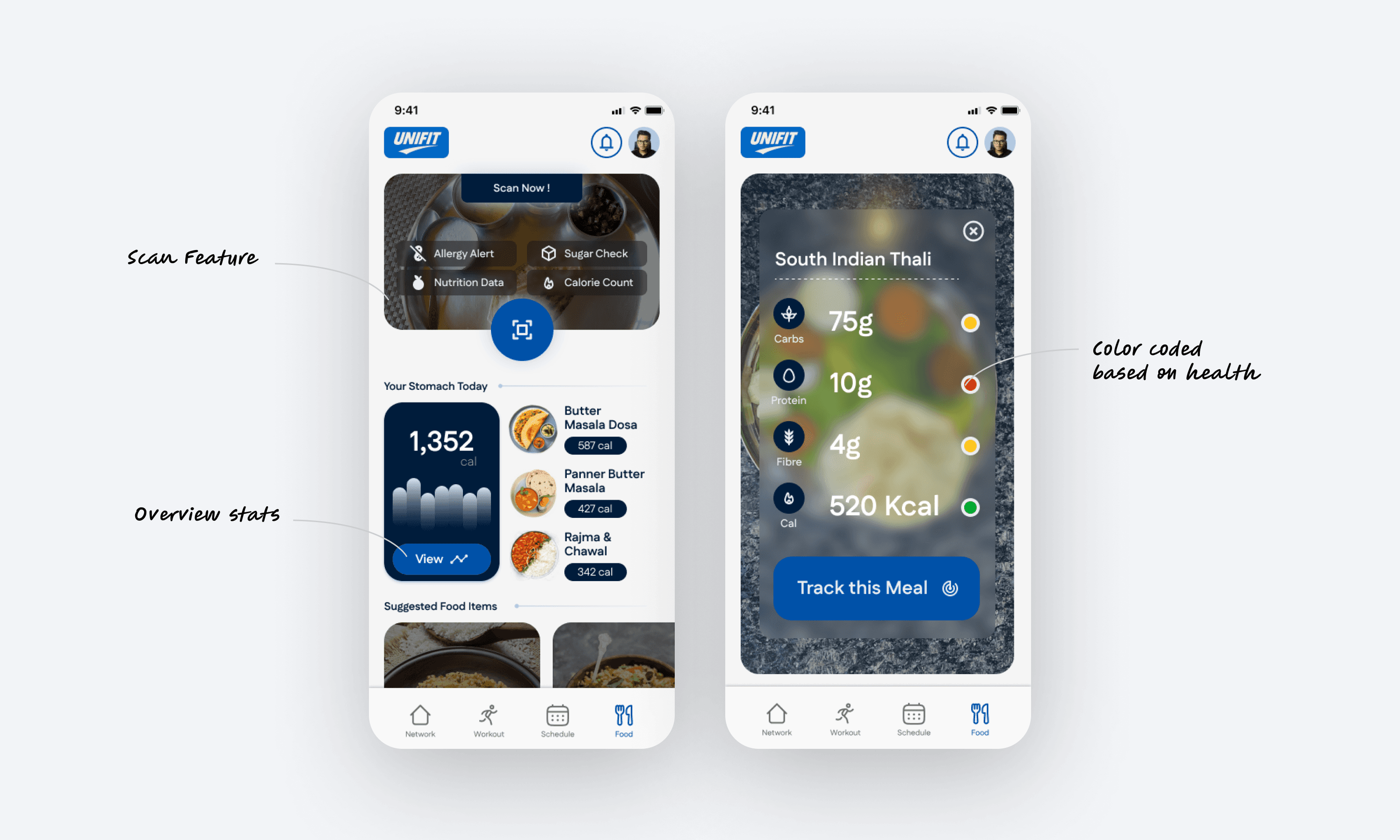
Camera-first logging reduces friction, and colour-coded macros translate nutrition into an instant health read
One primary action, minimal controls, and mode-specific visuals keep the user focused mid-workout, not managing the U
Decision-critical info is prioritised (distance, price, timing, type) so comparing gyms feels fast and low-effort
Progress is framed as small, finishable blocks with visible rewards, so motivation stays high without needing long sessions
A single reusable control handles add and edit states cleanly, so planning workouts alongside classes stays lightweight and consistent
Camera-first logging reduces friction, and colour-coded macros translate nutrition into an instant health read
A single glance surface that balances health signals (steps, sleep) with today’s academic reality, so users can act without digging
One primary action, minimal controls, and mode-specific visuals keep the user focused mid-workout, not managing the U
Decision-critical info is prioritised (distance, price, timing, type) so comparing gyms feels fast and low-effort
Progress is framed as small, finishable blocks with visible rewards, so motivation stays high without needing long sessions
A single reusable control handles add and edit states cleanly, so planning workouts alongside classes stays lightweight and consistent
Camera-first logging reduces friction, and colour-coded macros translate nutrition into an instant health read
VISUAL SYSTEM
A UI system built for fast decisions
I kept the UI lightweight, scannable, and repeatable so key actions like starting a workout, checking today’s schedule, finding a gym, and tracking a meal feel consistent across the app. The focus was clarity at a glance, strong hierarchy, and predictable states, so users can move between academics and fitness without friction.
I kept the UI lightweight, scannable, and repeatable so key actions like starting a workout, checking today’s schedule, finding a gym, and tracking a meal feel consistent across the app. The focus was clarity at a glance, strong hierarchy, and predictable states, so users can move between academics and fitness without friction.
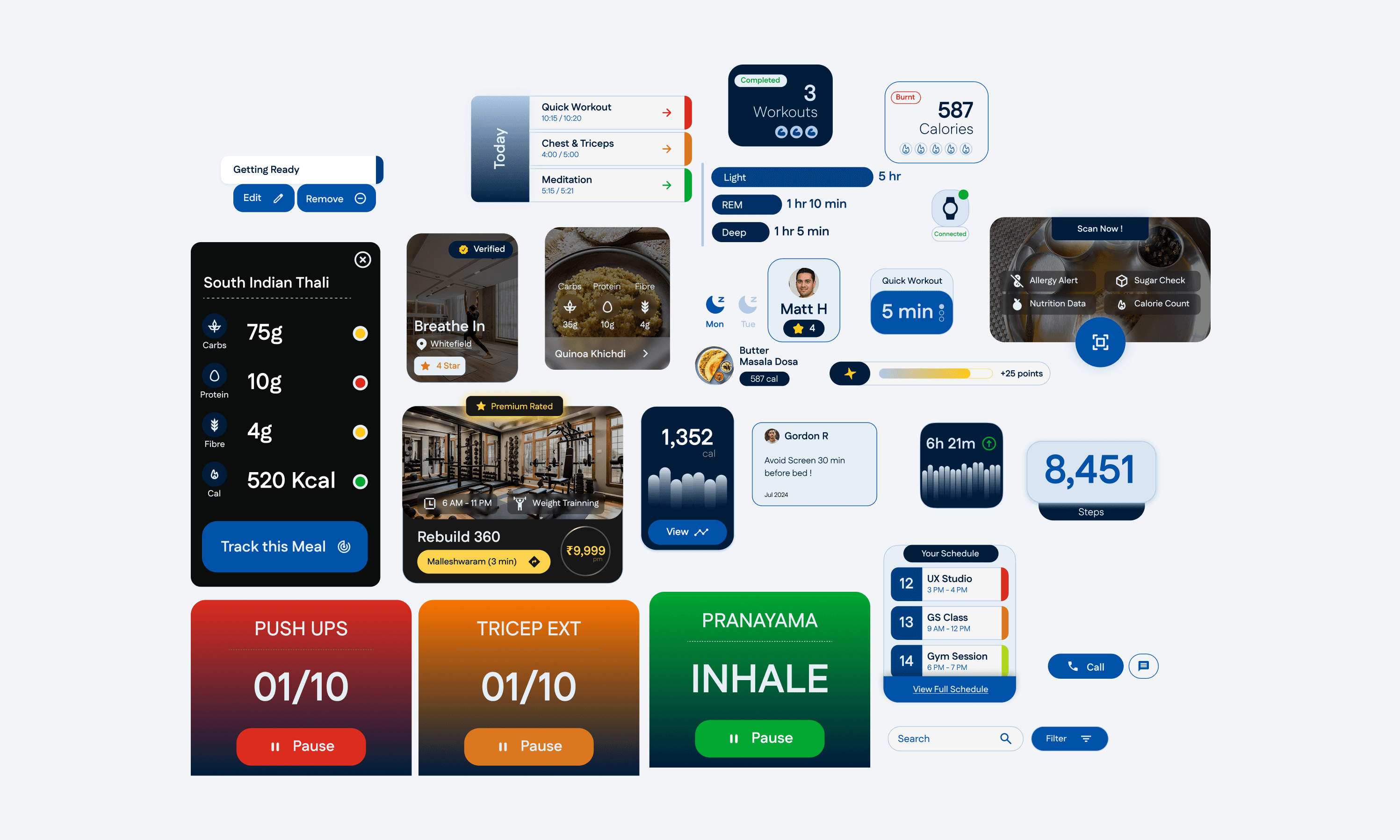
I defined a small set of reusable components for high-frequency actions: timers, workout cards, schedule blocks, scan-to-track inputs, and summary widgets. Components are designed to be read in seconds, with consistent spacing, clear labels, and state changes that guide the next step.
I defined a small set of reusable components for high-frequency actions: timers, workout cards, schedule blocks, scan-to-track inputs, and summary widgets. Components are designed to be read in seconds, with consistent spacing, clear labels, and state changes that guide the next step.
Routine-first dashboard
The home screens are built around the day’s routine: steps, sleep, quick workout, and today’s schedule sit together so users don’t have to jump tabs to plan action.
Multi-domain consistency
Academics, workouts, and food share the same interaction logic: cards, list blocks, and clear CTAs. The app feels like one system, not four separate modules stitched together
“Start now” over browsing
Routine-first dashboard
Quick workouts, timers, and one-tap actions are prioritised over exploration so users can act in the moment, even with low motivation or low time
The home screens are built around the day’s routine: steps, sleep, quick workout, and today’s schedule sit together so users don’t have to jump tabs to plan action.
Multi-domain consistency
Academics, workouts, and food share the same interaction logic: cards, list blocks, and clear CTAs. The app feels like one system, not four separate modules stitched together
“Start now” over browsing
Quick workouts, timers, and one-tap actions are prioritised over exploration so users can act in the moment, even with low motivation or low time
Visual hierarchy for low cognitive load
Big numbers and clear blocks do the heavy lifting: steps, calories, sleep hours, and macros are readable instantly, while secondary details stay tucked until needed.
Visual hierarchy for low cognitive load
Big numbers and clear blocks do the heavy lifting: steps, calories, sleep hours, and macros are readable instantly, while secondary details stay tucked until needed.
VISUAL SYSTEM
A UI system built for fast decisions
I kept the UI lightweight, scannable, and repeatable so key actions like starting a workout, checking today’s schedule, finding a gym, and tracking a meal feel consistent across the app. The focus was clarity at a glance, strong hierarchy, and predictable states, so users can move between academics and fitness without friction.
I defined a small set of reusable components for high-frequency actions: timers, workout cards, schedule blocks, scan-to-track inputs, and summary widgets. Components are designed to be read in seconds, with consistent spacing, clear labels, and state changes that guide the next step.
Routine-first dashboard
The home screens are built around the day’s routine: steps, sleep, quick workout, and today’s schedule sit together so users don’t have to jump tabs to plan action.
Multi-domain consistency
Academics, workouts, and food share the same interaction logic: cards, list blocks, and clear CTAs. The app feels like one system, not four separate modules stitched together
“Start now” over browsing
Quick workouts, timers, and one-tap actions are prioritised over exploration so users can act in the moment, even with low motivation or low time
Visual hierarchy for low cognitive load
Big numbers and clear blocks do the heavy lifting: steps, calories, sleep hours, and macros are readable instantly, while secondary details stay tucked until needed.
Routine-first dashboard
The home screens are built around the day’s routine: steps, sleep, quick workout, and today’s schedule sit together so users don’t have to jump tabs to plan action.
Multi-domain consistency
Academics, workouts, and food share the same interaction logic: cards, list blocks, and clear CTAs. The app feels like one system, not four separate modules stitched together
“Start now” over browsing
Quick workouts, timers, and one-tap actions are prioritised over exploration so users can act in the moment, even with low motivation or low time
Visual hierarchy for low cognitive load
Big numbers and clear blocks do the heavy lifting: steps, calories, sleep hours, and macros are readable instantly, while secondary details stay tucked until needed.
REFLECTION
REFLECTION
What I learned
What I learned
Better structure beats more features
Better structure beats more features
The 2025 version is less about adding new things and more about putting the right things in the right order. Once the home screen makes the next action obvious, the rest of the app feels lighter.
The 2025 version is less about adding new things and more about putting the right things in the right order. Once the home screen makes the next action obvious, the rest of the app feels lighter.
One life, one schedule
One life, one schedule
What makes Unifit different is the merge of academics and fitness into a single plan. The schedule is the product, workouts and classes are just the entries. That shift made the concept feel believable.
What makes Unifit different is the merge of academics and fitness into a single plan. The schedule is the product, workouts and classes are just the entries. That shift made the concept feel believable.
Feedback has to feel immediate
Feedback has to feel immediate
Steps, sleep, workout progress, and food tracking only work if the user gets quick reinforcement. I designed the flows so every action closes with a clear state change, not a vague screen transition.
Steps, sleep, workout progress, and food tracking only work if the user gets quick reinforcement. I designed the flows so every action closes with a clear state change, not a vague screen transition.
Iteration taught me where quality actually lives
Iteration taught me where quality actually lives
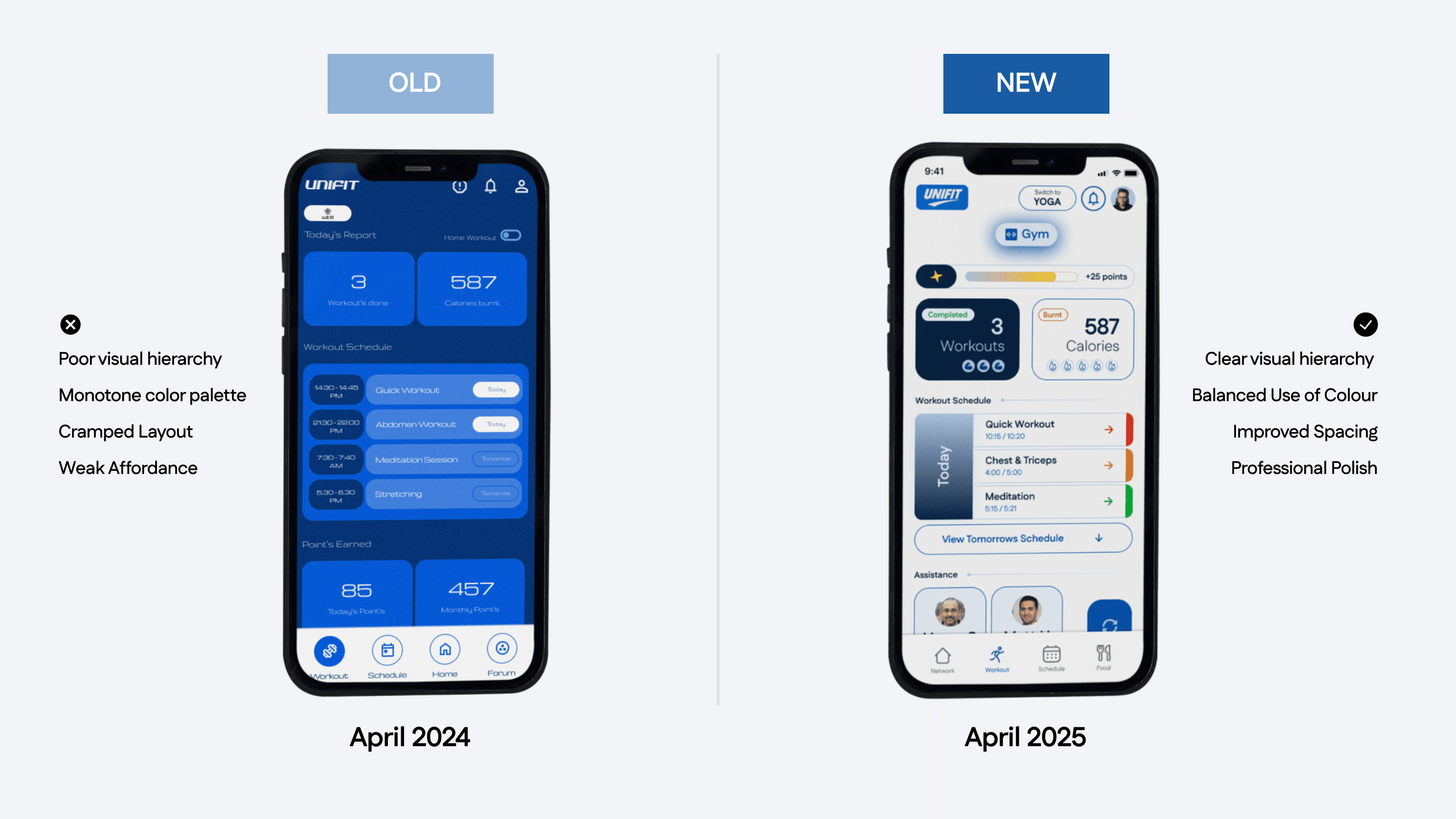
The April 2024 vs April 2025 comparison shows the gap between a working concept and a usable interface. The improvement came from details like spacing, hierarchy, and consistency, because that’s what decides whether people trust the system daily.
The April 2024 vs April 2025 comparison shows the gap between a working concept and a usable interface. The improvement came from details like spacing, hierarchy, and consistency, because that’s what decides whether people trust the system daily.